How AI Is Transforming Enterprise Learning Management Systems
Nearly 42% of companies are actively looking to replace their current LMS because it isn't delivering what they need. Most organizations have had a learning management system since employees first walked through induction. A wide range of content lives in it, courses get assigned, completion rates get tracked, and at the end of every quarter, someone pulls a report to see what percentage of training got finished.
What that report never answers is whether any of it is actually being applied. That gap, between content delivered and capability built, is the problem MimirAI was designed to close.
Read more on why completion rate is the wrong metric and what to track instead in Beyond Course Completion: L&D Metrics That Prove Business Impact. This piece addresses the Intelligence Layer Your LMS Has Been Missing.
The Intelligence Layer Your LMS Has Been Missing!
Where the Traditional Model Breaks Down
The conventional model for building corporate training carries a real cost that rarely shows up on a budget line. A course typically starts as an idea, moves through weeks of expert review, and lands in production for another stretch before anyone sees it. Multiply that timeline by every SOP, product update, or policy change that needs its own training material, and the pattern becomes clear: content is often stale before it's even fully rolled out.
That timeline was tolerable when business change moved slowly enough to wait for it. It no longer is. Every week spent in production is a week of L&D expertise diverted from the work that actually needs it, strategy, measurement, and figuring out whether training changes anything, and redirected instead toward manual content assembly. What's actually missing isn't more people or more hours. It's a system smart enough to shoulder the repetitive part of that work on its own.
Enterprises that keep treating content production as a purely manual craft are the ones absorbing that cost quarter after quarter, without a clear way to see it on a balance sheet.
Where Enterprise Learning Is Actually Heading
Independent 2026 analysis of the enterprise learning category converges on a consistent set of shifts:
-
AI is becoming infrastructure, not a feature. The platforms pulling ahead have AI woven into the underlying logic that determines what a learner sees next, not just AI sprinkled on top of an otherwise unchanged system.
-
Skills are outlasting courses. Job requirements now shift faster than any content library can be rebuilt to match, so platforms are organizing themselves around what a role actually requires rather than a fixed catalog of modules.
-
Measurement is moving from completion to capability. Leadership has largely stopped asking how much of a course got finished. The question now is whether the organization can actually do the thing the training was supposed to teach.
-
Generative AI is reshaping content production and reach. Script drafting, content refresh cycles, and multilingual localization are all compressing from a matter of months to a matter of weeks.
-
Learning is moving into the flow of work. Guidance embedded in the moment of need is proving more durable than content sitting in a separate portal nobody remembers to open.
-
Managers are emerging as the deciding factor. Whether training actually changes performance increasingly depends on manager visibility and reinforcement, not on L&D output alone.
-
Compliance training is becoming continuous rather than annual. Frequent, bite-sized refreshers are replacing the once-a-year obligation as regulatory pressure intensifies.
-
Platform experience itself is now a competitive differentiator. An interface that's genuinely pleasant to use, on a phone, without a training manual of its own, determines whether people actually come back.
Taken together, these shifts describe a single underlying expectation: enterprise learning platforms are expected to reason, not just store and deliver.
How AI Is Rewriting the Rules of Corporate eLearning, and What It Is Fixing
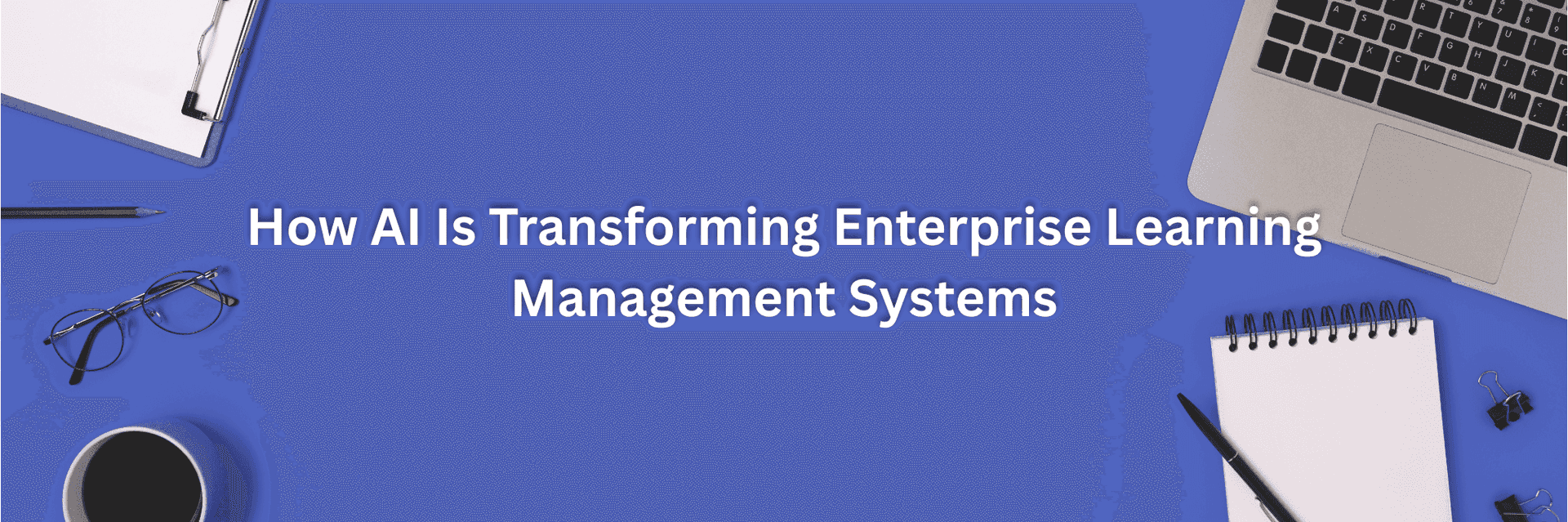
MimirAI is an AI-powered learning platform built by Tarento that operates on top of the LMS an enterprise already runs, converting static training into a system that adapts to the learner, responds in real time, and follows people into their actual work.
The distinction is deliberate, and it carries real strategic weight. MimirAI is built on the same premise driving the shifts above: AI as core infrastructure rather than an add-on feature, with one departure from most of the field: it becomes that infrastructure layer for the LMS an enterprise already owns, not for a new platform requiring a full migration first.
The architecture rests on three layers, each addressing a specific shortcoming named above.
Layer 1: Foundation
Before AI can generate value, the content it works with has to justify the investment.
Most enterprises are sitting on years of accumulated training material, documents, slide decks, videos untouched since the day they were uploaded. It is content in name only. In practice, it is information no one is going to engage with.
MimirAI's Foundation layer modernizes that material, converting static legacy content into dynamic, interactive, accessible learning assets through AI-powered summaries and interactive conversions. The objective is content people actively choose to engage with, not content they click past.
- The efficiency gain is measurable, not aspirational. Enterprise learning teams integrating AI into content workflows report cutting development timelines by close to half compared to fully manual production, per 2025 workplace-learning research, directly answering the production bottleneck described above.
- The same shift is reshaping global content strategy. MimirAI's multilingual UI support, detailed later in the architecture, is engineered for the same reach industry analysis describes: material expanding from a handful of languages to a dozen or more, in a fraction of the traditional time and cost, once localization becomes AI-assisted.
- Compliance content stands to benefit specifically. The Foundation layer is built to keep compliance material current continuously, rather than letting it lapse for another year until the next mandated refresh.
Layer 2: Intelligence
This is where the learning experience itself changes.
The Intelligence layer embeds AI directly into existing LMS workflows through what we call, an AI Bolt-Ons, delivering three specific capabilities.
An AI tutor resolves on-demand queries. A learner's question returns an answer grounded in the organization's own content, not a generic internet search. A new hire asking about internal process receives an answer that reflects that organization's actual process. This is not a category MimirAI originated: Intelligent Tutoring Systems are an established and actively advancing field within enterprise learning technology, distinguished by their capacity to identify an individual's specific knowledge gaps and adjust the experience in real time, at a scale no human facilitator could replicate across thousands of learners simultaneously.
Learning paths adapt to the individual. The system calibrates to each person's pace rather than moving every learner through an identical sequence at an identical speed, the same skills-architecture principle named above, applied directly.
Spaced repetition operates automatically. It remains one of the most rigorously proven principles in learning science: revisit material at the correct interval, and retention follows. MimirAI builds this in without requiring manual intervention, and the effect is quantifiable. AI-personalized learning has been associated with roughly a quarter higher knowledge retention than static, one-size-fits-all delivery, per recent workplace-learning research.
Layer 3: Assistance
The third layer relocates where learning actually happens.
Role-based AI assistants are embedded directly in the flow of work, operating in the context of what a person is doing rather than requiring a separate portal someone has to remember to open. A manufacturing operator receives guidance specific to their role and task. A supply chain planner receives the same, scoped to their own context. A commercial team member navigating a live client situation receives guidance relevant to that exact moment.
Learning ceases to be an activity scheduled in advance. It becomes a resource that surfaces precisely when required.
A second audience is engineered into this layer: managers, the deciding factor named above. MimirAI's personalized dashboard and its nudge and notification engine, both part of the experience layer described below, are designed with that audience in mind from inception, not appended later as a reporting mechanism.
What's Under the Hood
The generative AI architecture powering all three layers runs on a large language model paired with a vector database. Course video is transcribed, converted into embeddings, and stored in that database. When a learner submits a question, the system retrieves relevant context from the database, combines it with conversation history and a system prompt, and passes the result to the LLM. The response returned is contextual, grounded in the organization's own content, and informed by the learner's prior questions in that session.
This is what distinguishes the AI tutor from a search interface wearing a conversational front end. It retains context across a conversation, understands the material it was built on, and responds in real time with answers traceable to specific source content, not general knowledge that merely sounds credible.
The Architecture Behind It All
MimirAI's architecture divides into two operating layers. The AI layer sits above the core LMS layer and comprises the LLM and retrieval engine, the adaptive learning path engine, semantic content search, content modernization, and role-based AI assistants. The LMS layer, left entirely intact, handles course and content management, user and role management, assessment and certification, SCORM/LTI integration, and API gateway infrastructure.
The experience layer above both, what the learner actually encounters, comprises a web and mobile application, the AI tutor's conversational interface, a personalized dashboard, a nudge and notification engine, and multilingual UI support.
Interface quality is not a cosmetic afterthought in this architecture, echoing the experience-as-differentiator point named above directly. MimirAI's experience layer is engineered on that premise, not as a surface applied over the AI layer beneath it, but as a deliberate factor in whether the rest of the architecture gets used at all.
The system is built from reusable AI components in a modular architecture, engineered for rapid deployment and continuous evolution rather than a monolithic system requiring a full rebuild each time the underlying models advance.
MimirAI Architecture: Frequently Asked Questions
1. Does MimirAI replace our existing LMS?
No. MimirAI is engineered as an intelligence layer that operates on top of the LMS an enterprise already runs, connecting through SCORM/LTI integration and an API gateway. It is built specifically for organizations that require AI-powered capability without undertaking a full LMS migration.
2. What is an AI Bolt-On?
Tarento's designation for the specific AI capabilities that integrate directly into existing LMS workflows: an AI tutor for on-demand queries, adaptive learning paths calibrated to individual pace, and automatic spaced repetition. Each operates on content already in place rather than requiring a separate content library.
3. How does the MimirAI tutor generate its answers?
Through a retrieval-augmented generation architecture. Course video is transcribed and converted into embeddings stored in a vector database. When a learner submits a question, the system retrieves relevant context from that database, combines it with conversation history, and passes it to an LLM, ensuring the answer is grounded in the organization's own content rather than the model's general training data.
4. What does the Foundation layer do to legacy content?
It converts static legacy material, documents, slide decks, video, into dynamic, interactive, accessible learning assets through AI-powered summaries and interactive conversions, rather than allowing that content to remain unused in its original format.
5. Where do the role-based AI assistants actually appear?
Inside the flow of work itself, not within a separate learning portal. A manufacturing operator, a supply chain planner, and a commercial team member each receive guidance relevant to their specific role and task, delivered in context rather than requiring them to log into a separate training system.
MimirAI closes the gap between content delivered and capability built: an intelligence layer that modernizes legacy training, personalizes it by role, and grounds every answer in an organization's own content, all without replacing the LMS already in place. See how that architecture applies to your existing platform. Explore MimirAI.


MuleSoft to SAP Integration Suite: A Migration Path That Doesn't Start From Zero