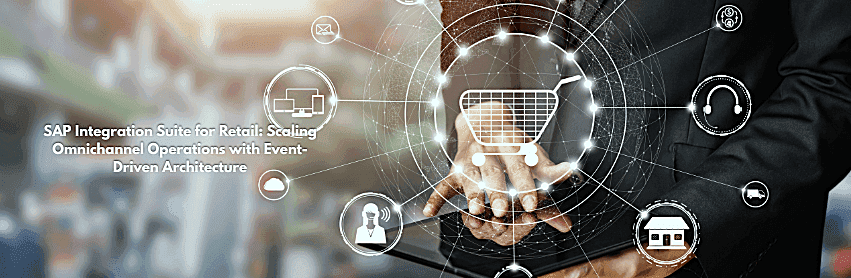
SAP Integration Suite for Retail: Scaling Omnichannel Operations with Event-Driven Architecture
Retail integration has always been demanding. But the gap between what a traditional integration layer can handle and what omnichannel retail now requires has become difficult to close with legacy approaches.
For a leading Nordic destination for electronics, appliances, and everyday technology, SAP Integration Suite for retail became the foundation for scaling omnichannel operations across 400+ stores in six countries. The challenge was not future-state transformation. It was live, daily, and growing — millions of messages, tens of thousands of orders, and the expectation that nothing would slow down when the business needed to run fastest.
The integration layer had to keep pace. And it had to do so without disruption.
The Problem With Integration at Retail Scale
Retail operations at this scale are not a single system problem. They are a coordination problem across dozens of systems: e-commerce platforms, ERP, warehouse management, supplier networks, loyalty programmes, and physical store systems — all of which need to exchange data reliably, in near real-time, at unpredictable volumes.
Traditional integration architectures handle predictable, bounded load reasonably well. They are not designed for the traffic spikes that define retail — a promotional event, a Black Friday surge, or a regional product launch can multiply message volumes by an order of magnitude within hours.
The same architecture that processes orders smoothly on a quiet Tuesday becomes a constraint on the days that matter most. And in retail, disruption during peak periods is not an operational inconvenience — it is a direct revenue and customer trust problem.
The business needed an integration platform that treated peak load as normal operating conditions, not as an exception to be managed around.
What the Architecture Had to Do
The requirements were specific and non-negotiable.
The platform needed to handle high message volumes continuously — not just survive peaks, but scale into them without manual intervention. It needed to support real-time, event-driven data flows across systems, rather than relying on batch-based patterns that introduce latency into inventory updates, order confirmations, and pricing changes.
Security was a parallel requirement. The retailer's commerce systems serve both employees and customers, each with different access patterns and identity models. The platform needed to enforce secure access across both groups, at the API and identity layers, consistently across every channel.
Visibility was the third requirement. A platform processing millions of daily messages that lacks monitoring and alerting is not resilient — it is a system where failures accumulate silently until they surface as customer-facing incidents. Operational observability was built into the scope from the start.
Building a Retail Integration Platform on SAP Integration Suite
Tarento built a modern hybrid integration platform for the retailer on SAP Cloud Integration, paired with a highly scalable event-driven architecture designed to meet the operational demands of Nordic retail.
The event layer was built on Confluent Kafka and Azure Service Bus. Kafka handled high-throughput, persistent event streaming — the backbone for real-time data flows across systems at volume. Azure Service Bus managed message queuing and delivery guarantees for scenarios requiring reliable, ordered processing. Together they gave the platform the elasticity to absorb traffic spikes without degrading throughput or dropping messages.
Primary-secondary tenant synchronisation was handled through microservices tooling. The retailer's SAP environment required consistent data state across tenants. Microservices-based sync ensured that changes propagated correctly and completely, without manual reconciliation or batch dependency.
Identity and access was built on Azure AD. Employee-facing systems used Azure AD SSO with JWT and SAML for identity propagation and secure API access. Customer-facing commerce was secured through Azure AD B2C, providing scalable, policy-driven access management across external channels. Both models were integrated into the API layer, ensuring consistent enforcement across every integration flow.
Monitoring, alerting, and log tracking were built into the platform from the start. Operational visibility was not added after delivery — it was part of the architecture. This meant that when volumes spiked, the team had the information needed to act, not the need to investigate first.
SAP Integration Suite Retail Outcomes at Scale
| Metric | Outcome |
|---|---|
| Daily message volume | 3M+ messages processed per day |
| Monthly API calls | 30M+ calls managed via SAP API Management |
| Integration flows | 300+ SAP CI integration flows in production |
| Daily order volume | 50K+ retail orders processed daily |
| Peak performance | Zero disruption during Black Friday |
| Access coverage | Commerce access secured for employees and customers |
| Observability | Monitoring, alerting, and log tracking active across the platform |
The numbers reflect a platform operating continuously at retail scale — not one that passes load tests in a controlled environment and then performs differently in production.
Why Event-Driven Retail Integration Architecture Matters
The combination of SAP Cloud Integration, Confluent Kafka, and Azure Service Bus is not an obvious pairing for teams accustomed to single-platform integration thinking. It reflects a deliberate architecture decision: use the right tool for each layer of the integration problem, and compose them into a platform that is coherent at the operational level.
SAP Cloud Integration provides the integration logic, mapping, and orchestration that connects the retailer's SAP estate to the broader system landscape. Confluent Kafka provides the event streaming infrastructure that can absorb the volume and velocity of real retail data. Azure Service Bus adds the reliability and ordering guarantees that specific integration scenarios require.
None of these components is the answer on its own. The architecture works because each layer addresses a different constraint — and because the operational layer ties them together into something the team can manage and trust at scale.
The identity architecture reflects the same thinking. Employee access and customer access carry different risk profiles and policy requirements. Treating them as the same problem leads to compromises in both directions. Separating them — Azure AD SSO for internal identity, Azure AD B2C for external — allows each model to be managed correctly without forcing a single approach onto scenarios that need different treatment.
Why Retailers Are Modernising Omnichannel Integration
Most retail integration failures are not technology failures. They are scope and sequencing failures.
Teams design for the average case and discover the peak case in production. Event-driven architecture is added later, after synchronous patterns have already been embedded into critical flows. Observability is treated as an operations concern rather than an architecture requirement.
The consequence is a platform that works most of the time and fails at exactly the wrong moment — during peak periods, promotional events, or high-traffic launches when the business most needs the integration layer to hold.
This programme inverted that sequence. The architecture was designed around peak load from the start. Event-driven patterns were the primary integration model, not a retrofit. Monitoring was built into the delivery, not bolted on after go-live. That sequencing is why the platform delivered zero disruption during Black Friday — not as a target, but as an outcome of how it was designed.
The Broader Retail Integration Context
The demands on retail integration infrastructure are increasing in one direction. More channels, higher order volumes, shorter fulfilment windows, and real-time inventory visibility across physical and digital estates are now table stakes for competitive retail operations, not differentiators.
Integration platforms built around synchronous, batch-heavy, or monolithic patterns cannot evolve to meet those demands without significant re-architecture. The enterprise integration modernisation question retailers are facing in 2026 is not whether to change the integration layer — it is whether to change it proactively or reactively.
This investment in a modern, event-driven hybrid integration platform was a proactive decision. The 3M+ daily messages, 50K+ daily orders, and Black Friday performance are evidence of what that decision enabled — and what becomes possible when the integration layer is treated as a strategic asset rather than a background utility.
Explore Tarento's Enterprise Integration practice and how we help retail and enterprise clients build integration platforms that scale with the business.

Distributed Systems Reliability: 5 Principles That Separate Resilient Architectures From Fragile Ones