Enterprise AI Tutors: How to Get Trustworthy Answers from Training Content
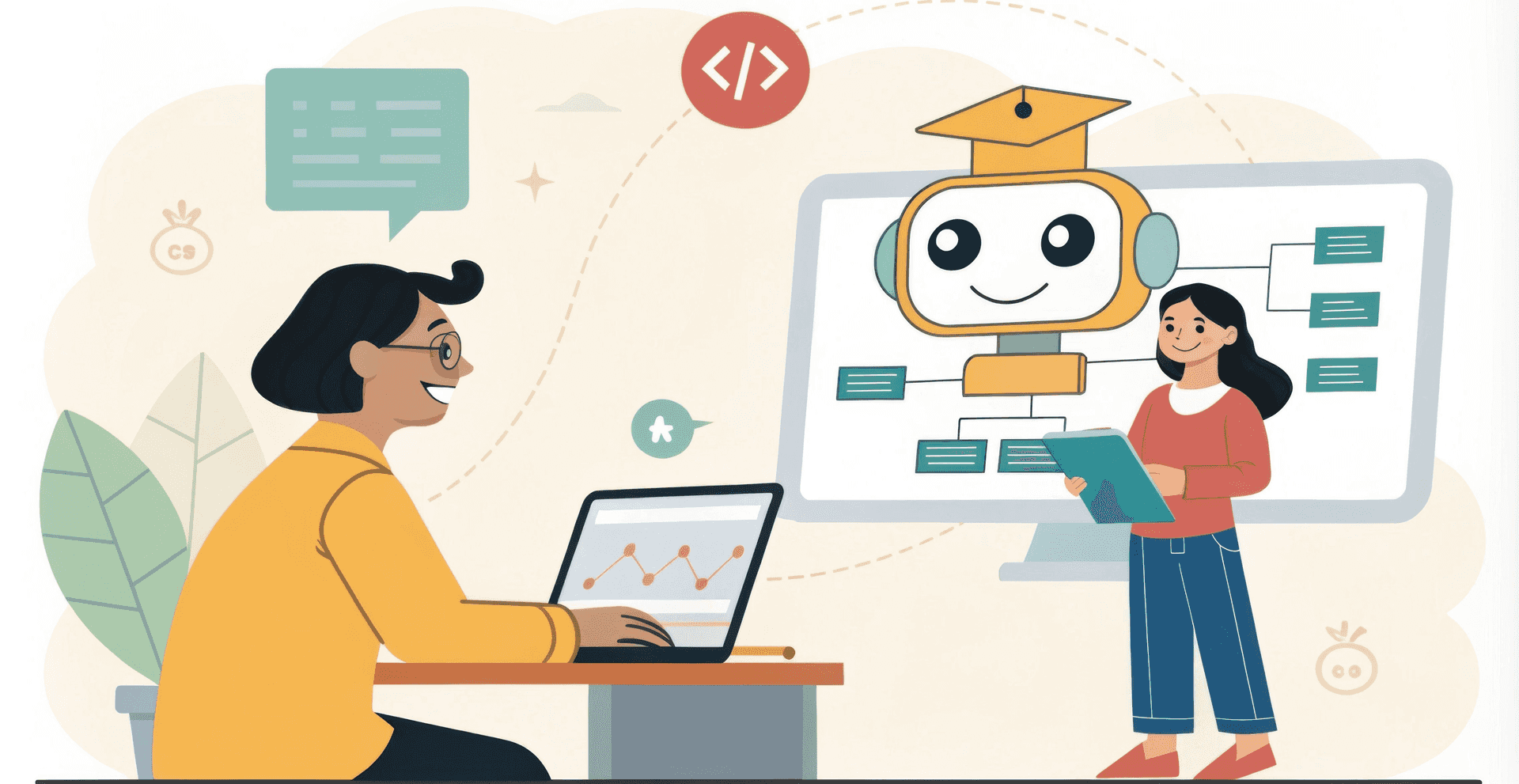
An enterprise AI tutor is a conversational learning assistant that helps employees find answers in an organisation's approved training materials, policies and process documentation. Instead of searching through courses, PDFs and knowledge repositories, employees can ask questions in natural language and receive a relevant explanation, ideally with a direct reference to the original source.
Most employees recognise the problem it is designed to solve. A question comes up about a process, product or policy. The answer exists somewhere, but finding it means searching through internal knowledge bases, shared folders and old training materials. When that fails, the employee turns to a colleague who may be equally busy.
An AI tutor makes this information easier to access. Many use retrieval-augmented generation (RAG) to identify relevant passages in company content before generating an answer. However, retrieving information from an approved source does not automatically make the response correct. Outdated policies, incomplete retrieval, incorrect interpretation and inadequate access controls can still produce unreliable answers.
For organisations considering an enterprise AI tutor, the important question is not simply whether it can answer employee questions. It is whether those answers are accurate, verifiable, current and appropriate for the employee asking.
This article explains how enterprise AI tutors work, what makes their answers trustworthy, how they connect with existing learning management systems and what organisations should evaluate before deployment.
Training Ends, Work Continues
Organisations invest considerable effort in employee training. Courses are developed, onboarding programmes are delivered, assessments are completed and learning records are updated. Then the training ends, and employees return to their daily responsibilities.
That is often when the most practical questions begin.
A new hire needs to confirm a step from onboarding. A manager wants to check an approval process before making a decision. A field technician needs to consult a procedure while working with equipment. A sales representative wants to verify a product detail before meeting a customer.
The information may have been covered during training, but finding it again can mean navigating lengthy courses, searching shared folders or asking someone who remembers the answer.
This gap between learning something and applying it is where an enterprise AI tutor can help.
Rather than expecting employees to remember where information was taught, the tutor makes approved knowledge easier to access when it is needed. The objective is not to replace formal training but to extend its usefulness into everyday work.
What Is an Enterprise AI Tutor?
An enterprise AI tutor is an AI-powered learning assistant that helps employees understand and apply information from approved organisational content.
Depending on its capabilities, it can answer questions, explain unfamiliar concepts, direct employees to relevant learning materials and recommend additional training based on their roles or learning progress.
An enterprise AI tutor may resemble an internal search engine or a general-purpose AI assistant, but its primary purpose is to support workplace learning.
| Capability | Enterprise search | General-purpose AI assistant | Enterprise AI tutor |
|---|---|---|---|
| Primary purpose | Find relevant enterprise information | Assist with a broad range of tasks | Support employee learning and knowledge application |
| Information sources | Indexed documents and connected systems | Model knowledge and configured sources | Approved learning and process content |
| Typical response | Search results, summaries or answers | Conversational responses | Learning-oriented explanations, ideally with source references |
| Company-specific knowledge | Depends on connected sources | Depends on connected sources | Depends on approved and indexed learning content |
| Role-based learning support | Possible through additional integrations | Possible through configuration | Can connect to learning paths and competency records |
| Main limitation | Relevant information may be difficult to identify | Answers may be inaccurate or lack organisational context | Retrieved content may be outdated, incomplete or misinterpreted |
These categories increasingly overlap. Enterprise search platforms can generate answers, while general-purpose AI assistants can work with internal company documents.
A dedicated enterprise AI tutor is distinguished less by its conversational interface and more by its learning context, content governance and potential connection to employee development.
For example, an internal search assistant may locate a cybersecurity policy. An enterprise AI tutor may explain the relevant requirement, direct the employee to the policy and recommend a short refresher module where further learning is needed.
Whether it can perform all these functions depends on the product and its implementation.
How an Enterprise AI Tutor Answers from Company Content
Many enterprise AI tutors use retrieval-augmented generation (RAG) to connect a language model with approved organisational knowledge. Instead of relying entirely on information learned during model training, a RAG-based system retrieves relevant content when an employee asks a question and uses that information to construct a response.
The process generally involves four stages:
1. Content Ingestion and Indexing
Training materials such as courses, policies, PDFs, presentations, standard operating procedures and video transcripts are collected from approved sources. The content is processed and indexed so relevant passages can be retrieved when needed. This involves more than simply uploading documents. Materials may need to be cleaned, divided into searchable sections and associated with information such as ownership, version, department, permissions and effective date. When several versions of a policy exist, the system needs a reliable way to distinguish the current approved version from outdated material.
2. Retrieving Relevant Information
When an employee asks a question, the system searches its indexed content for relevant information. Retrieval may use semantic embeddings, keyword search or a combination of both. Semantic retrieval helps identify passages with similar meanings even when the wording differs. Keyword retrieval remains useful for exact policy names, technical terminology, document identifiers and other information where precise wording matters. Some implementations also use reranking to improve relevance and permission filtering to ensure employees only receive information they are authorised to access. For example, someone asking how to get reimbursed for travel expenses may be directed to a document titled "Employee Expense Claims", even though the question and document use different wording.
3. Generating an Answer
The language model uses the retrieved information to construct a response. A well-designed implementation can provide a concise explanation, identify the supporting document and direct the employee to the relevant section. The response should remain within the scope of the available information rather than filling gaps with assumptions.
4. Verification and Feedback
The final stage focuses on whether the answer can be trusted. Employees should be able to inspect the supporting source, flag an incorrect explanation or seek clarification when the available information is insufficient. For organisations developing these capabilities internally, retrieval design, model evaluation and operational safeguards are important considerations in generative and agentic AI development. A system that can generate an answer is not necessarily a system that can substantiate it.
Why Answering from Company Content Does Not Guarantee Accuracy
Grounding an AI tutor in organisational content can help make answers more relevant to company-specific processes and requirements. However, it does not eliminate errors. A retrieval system may miss the correct passage, select outdated material or retrieve information that applies to a different situation. Even when the appropriate source is retrieved, the language model may interpret it incorrectly or omit important context. Source citations are useful, but they are not sufficient on their own. An answer may reference a genuine document without accurately reflecting what that document says. For an enterprise AI tutor, trustworthy answers therefore depend on the controls surrounding the model as much as the information available to it.
Six Controls That Make Enterprise AI Tutor Answers More Trustworthy
1. Verifiable Source Citations
Answers should identify the document, course or section supporting the response. Where possible, employees should be able to open the original source directly. A citation is useful only when the referenced material actually supports the answer.
2. Clear Handling of Unanswered Questions
When the available information is insufficient, the tutor should acknowledge the limitation rather than invent an answer. For important questions, it should direct employees to the appropriate document owner, subject-matter expert or approved process.
3. Content Ownership and Version Control
Each important content area needs an accountable owner. When policies or procedures change, outdated versions should be retired and the retrieval index updated. Without this process, the tutor may retrieve information that is no longer valid.
4. Permission-Aware Retrieval
Employees should only receive information they are authorised to access. Access controls should be enforced during retrieval and response generation, rather than relying solely on what is visible in the user interface.
5. Evaluation Using Real Workplace Questions
Before deployment, organisations should test the tutor against representative employee questions with agreed reference answers. Evaluation should examine factual accuracy, retrieval relevance, citation correctness, appropriate handling of unanswered questions and behaviour when documents conflict. Testing should be repeated after important content, model or configuration changes.
6. Feedback and Correction Mechanisms
Employees need a straightforward way to flag inaccurate or unhelpful responses. Those reports should reach the relevant content or system owner, with a defined process for investigation, correction and retesting. For safety-critical work, an AI tutor should support access to controlled procedures rather than replace them. A technician asking how to isolate a production line, for instance, should be directed to the current approved operating procedure and relevant safety requirements. An AI-generated explanation must not become an unauthorised substitute for formal instructions.
Where Enterprise AI Tutors Add Value: Learning in the Flow of Work
An AI tutor becomes particularly useful when employees can access it at the moment a question arises, often outside a formal training environment.
Two common enterprise scenarios illustrate this:
1. Manufacturing: Guidance at the Point of Need
A plant operator needs to verify a step in a standard operating procedure while working near equipment. Instead of leaving the production area to search through training materials, the employee can consult an approved knowledge assistant on a suitable device. The assistant can help locate the relevant procedure, explain unfamiliar terminology and direct the operator to the controlled document. In manufacturing environments, access to current approved procedures and compliance with safety requirements must remain the priority. AI assistance should support employees in understanding authoritative instructions, not independently authorise operational decisions.
2. Sales Enablement: Finding Information Before a Customer Conversation
A sales representative is preparing for a meeting and needs to confirm product positioning, eligibility requirements or a pricing policy. The information may be buried inside an extensive training course or presentation. An AI tutor connected to current approved materials can help locate the relevant information without requiring the employee to revisit the entire course. It can also direct the representative to additional learning when the question reveals a knowledge gap. In both scenarios, the value comes from timely access to relevant information. That value depends on the system returning accurate, current and appropriately authorised content.
How an Enterprise AI Tutor Integrates with Your Existing LMS
Introducing an enterprise AI tutor does not necessarily require replacing the learning management system. In many environments, the tutor can work alongside an existing LMS, using supported integrations to access learning content, launch learning experiences or report activity. For a broader explanation, see AI LMS vs Traditional LMS: What Changes for Enterprise Learning.
Three common learning technology standards serve different purposes.
1. LTI: Launching External Learning Tools
Learning Tools Interoperability, or LTI, enables learning platforms to connect with external learning tools. LTI 1.3 supports secure tool launching and can allow an AI tutor to appear within an existing learning environment. However, LTI integration does not automatically provide access to every course document, assessment or learning asset stored within the LMS. Content retrieval still requires suitable APIs, permissions and supported access mechanisms.
2. xAPI: Tracking Learning Activity
The Experience API, or xAPI, provides a standardised way to record learning activities as structured statements. These statements can be stored in a Learning Record Store and may describe learning interactions occurring beyond a traditional LMS. For an enterprise AI tutor, xAPI can support tracking relevant learning activities when the tutor and surrounding platform are configured to generate and record those statements. Organisations must decide which events should be recorded, how they relate to individual learners and which privacy controls apply.
3. SCORM: Accessing Existing Course Content
SCORM is commonly used to package e-learning courses and communicate completion and assessment information to learning management systems. Many organisations maintain substantial libraries of SCORM-based training material. However, supporting SCORM delivery does not automatically mean an AI tutor can retrieve and interpret all the content within those packages. Depending on the course structure, content ingestion may require extraction of learning assets, additional processing and transcription of video or audio. When evaluating a tutor, organisations should check how it accesses existing materials, maintains permissions and responds when courses are updated. The most important integration question is not simply whether the tutor supports LTI, xAPI or SCORM. It is whether employees can consistently access accurate information from the current approved version of their learning materials.
Governance, Privacy and Responsible AI in Enterprise Learning
An enterprise AI tutor may process employee questions, learning histories, assessment records and information about workplace competencies.
These capabilities introduce governance considerations that organisations should address before deployment.
Employee questions and learning records may contain personal or commercially sensitive information. Organisations should establish appropriate access controls, retention policies, data processing responsibilities and safeguards for external technology providers. IT, HR, legal and data protection teams should understand where information is hosted, which systems process it, whether prompts and responses are retained and who can access individual employee records. Depending on the organisation and its operating environment, workforce consultation or employee representative requirements may also need consideration.
When Does an AI Tutor Require Additional Governance?
An AI tutor that provides informational assistance presents different risks from a platform used to assess employee performance or influence career decisions. The distinction becomes important when an enterprise learning system extends beyond answering questions. For example, helping an employee find an approved course involves different responsibilities from generating competency scores that influence promotion, performance evaluation, task allocation or career progression. Organisations should evaluate how the platform's outputs are used, who can act on them and what oversight is required. Where AI contributes to assessments or employee-related decisions, the organisation should establish suitable review processes, transparency measures and human oversight. The objective is to ensure that learning assistance improves employee capability without introducing unnecessary privacy, fairness or accountability risks.
Where MimirAI Fits into Enterprise Learning
MimirAI is Tarento's AI-driven enterprise learning platform, designed to help organisations move beyond course completion toward workforce capability development. It combines AI-powered personalisation, competency assessment, learning content development and learning-platform performance engineering. For employees, this means learning support can extend beyond assigned courses. The platform brings together learning copilots, role-specific learning paths, adaptive recommendations and microlearning experiences. Its approach is broader than a standalone question-answering assistant.
1. Learning Support Connected to Role Requirements
MimirAI uses role and competency frameworks to help organisations identify expected capabilities and assess employee development. Its Competency Passbook is designed to provide a structured view of role requirements, demonstrated progress and development areas. Learning recommendations can then be connected to identified needs rather than relying entirely on a general course catalogue. This becomes relevant when an employee's question points to a broader training requirement. A workplace learning assistant can help address the immediate question, while the wider learning platform can support additional training or assessment where appropriate.
2. Modernising the Content Behind Learning
A learning assistant is only as useful as the information available to it.
MimirAI's approach includes AI-assisted content modernisation, helping organisations transform legacy PDFs, presentations and text-heavy learning materials into more structured, interactive and mobile-friendly experiences. This addresses a common enterprise learning challenge: important information exists, but it is not always easy to access, update or apply. Modernising content can improve accessibility and consistency. However, important training materials should still undergo subject-matter review, approval and version control, particularly where compliance or safety requirements are involved.
3. Supporting Learning Platform Performance
MimirAI also brings together performance engineering and managed services for enterprise learning environments.
The MimirAI enterprise learning case study illustrates how learning experiences, content modernisation and platform capabilities can be considered together. For organisations evaluating an AI tutor specifically, the most useful next step is to test the assistant against their own content, employee questions and governance requirements. Capabilities such as source citations, permission-aware retrieval, handling of unanswered questions and response accuracy should be demonstrated and evaluated rather than assumed from the broader platform's features.
Ten Questions to Ask Any Enterprise AI Tutor Vendor
A useful vendor evaluation should go beyond a polished demonstration.
The following questions help organisations understand whether a proposed AI tutor can support real workplace learning requirements.
- Can employees verify the answer? Does the system identify the correct source document, version and section, and does that source support the response?
- What happens when an answer is unavailable? Can the tutor acknowledge uncertainty and direct the employee to an approved source?
- Which content formats can it access? How does it handle PDFs, presentations, SCORM packages, videos, transcripts and structured learning content?
- How are content updates managed? When a policy changes, how quickly is the retrieval index updated, and how are outdated versions excluded?
- Does it respect employee access permissions? Are permissions enforced during retrieval and answer generation?
- How is company data protected? Which systems process information, where is it hosted, how long is it retained and is it used for model training?
- How is answer quality evaluated? Can the vendor demonstrate accuracy, citation correctness, retrieval relevance and appropriate handling of unknown questions using the organisation's own test set?
- How does it integrate with the LMS? Which capabilities use LTI, xAPI, SCORM or platform-specific APIs, and how is content synchronised?
- Who can see employee interactions? What controls govern access to question histories, assessments and learning records?
- Does it influence employee evaluations? Are learning outcomes or competency scores used for performance, promotion or other employment decisions, and how is that use governed?
These questions help distinguish a conversational interface from a learning system that can be managed responsibly across an enterprise.
Frequently Asked Questions
Can an AI Tutor That Uses Company Content Still Give Wrong Answers?
Yes. Retrieval-augmented generation can improve how answers are grounded in approved information, but it does not eliminate errors. The system may retrieve outdated or incomplete content, select the wrong source or misinterpret a correct passage. Organisations should evaluate AI tutor accuracy using representative employee questions and verify that source citations genuinely support the answers.
What Content Does an Enterprise AI Tutor Need?
An enterprise AI tutor typically uses approved training courses, company policies, standard operating procedures, product documentation, process guides and other learning resources. Training videos and audio may also be useful when accessible transcripts are available. Content quality matters more than volume. Duplicate, outdated or contradictory documents can lead to unreliable answers, making content ownership and version control important.
Do We Need to Replace Our LMS to Use an AI Tutor?
Not necessarily. An enterprise AI tutor can work alongside an existing LMS, depending on supported integrations and platform architecture. LTI can support launching an external tool, xAPI can record configured learning activities, and APIs or exports may provide access to course materials. The main requirement is ensuring that approved content remains accessible, current and appropriately permissioned.
How Is an Enterprise AI Tutor Different from a General Enterprise AI Assistant?
A general enterprise AI assistant can support a wide range of workplace tasks, including document search, content drafting and information retrieval. An enterprise AI tutor focuses more specifically on learning-related activities, such as explaining approved training material, helping employees apply knowledge and connecting assistance to learning progress. The distinction is not absolute. Organisations may use both types of tools, with clearly defined responsibilities for content access, governance and employee development.
Does an Enterprise AI Tutor Require Additional Governance?
Yes, particularly when it processes employee information, records learning activity or contributes to competency assessments. The level of oversight depends on the information involved and how the system's outputs are used. An assistant providing informational guidance may require different controls from a platform whose assessments influence performance or career decisions. Organisations should review privacy, access, transparency and human oversight requirements before deployment.
How Should Organisations Measure Whether an AI Tutor Is Working?
Useful measures include answer accuracy, citation correctness, retrieval relevance, time taken to find information, appropriate handling of unanswered questions and employee feedback. Organisations can also examine whether the tutor reduces repeated questions to subject-matter experts or helps employees apply training more effectively. Where possible, compare performance with the existing process and establish measurement criteria before rollout.
Test an Enterprise AI Tutor Against Your Own Training Content
The most useful AI tutor evaluation begins with the questions employees already ask.
Take a representative collection of approved courses, policies and process documents. Identify the questions employees regularly struggle to answer and establish the correct responses with subject-matter experts.
Then test whether the proposed tutor retrieves the right information, explains it accurately, cites the appropriate source and handles information gaps without improvising.
That exercise reveals more about enterprise readiness than a demonstration built around carefully selected questions.
Tarento's Rapid L&D Experience and Impact Audit offers a broader starting point for examining an organisation's learning environment. The assessment can consider five dimensions: learner experience, content quality, technical performance, analytics capability and alignment with business outcomes.
For organisations exploring enterprise AI tutors, these findings can help identify whether the immediate priority is better content access, more current learning material, improved LMS integration or a wider improvement to the learning experience.
Request an L&D Experience and Impact Audit · Explore MimirAI


Tarento: A Premier Delivery Partner for Infor ERPs