Cloud Migration Strategy 2026: How Enterprises Are Rebalancing Cost, Risk and Repatriation
After more than a decade of cloud-first thinking, enterprise IT has entered a quieter, more disciplined phase. Worldwide public cloud spending crossed $723 billion in 2025 according to Gartner, and the cloud migration services market is projected to reach $31.5 billion in 2026. The headline is still growth. The shape of that growth has changed.
The 2026 enterprise cloud migration strategy is a more honest reckoning with cost, resilience, sovereignty and AI workload economics. This guide sets out what has shifted, why it matters, and how to build a migration approach that survives contact with finance, security and the regulator.
From cloud-first to cloud-appropriate
The decade of "cloud-first" produced two real outcomes. The first was a generation of cloud-native businesses that could not have existed on legacy infrastructure. The second was a substantial cohort of workloads lifted and shifted into expensive cloud environments where they did not belong.
The rebalance is now visible in every major survey. The Barclays Survey reports that 83-86% of CIOs plan to move at least some public cloud workloads back to private cloud, on-premise or colocation. IDC's data suggests around 80% of enterprises expect to repatriate some compute or storage workloads within 12 months. Importantly, only around 8% of organisations are moving entire workloads off public cloud. This is not an exit. It is selection discipline.
The right framing is cloud-appropriate placement: each workload sized to the venue that best fits its cost, performance and regulatory profile. In practice, hybrid is now the operating reality for most large enterprises.
Why cloud migrations still go wrong
McKinsey's research on cloud migration found that programmes run an average of 14% over budget, with 38% of migrations delayed by more than a quarter. The failure modes have not changed much since 2020. The expectations have.
The recurring failures in 2026 migrations:
- Lift and shift by default. Moving on-premise workloads into IaaS without re-architecting preserves every inefficiency and amplifies the cost.
- Incomplete dependency mapping. Hidden integrations and shared services surface only after cutover, often as production outages.
- Underestimated egress, storage tier and licensing costs. The list price of a VM is rarely the actual run-rate.
- Overly permissive identity and access policies. Still one of the most common root causes of cloud security incidents.
- No documented exit strategy. Long-term portability is the price of long-term negotiating power, and it has to be designed in at architecture time, not contract time.
- Cloud treated as an IT project. Without early involvement from finance, legal and compliance, downstream surprises are guaranteed.
The pattern is consistent across analyst sources and matches what most enterprises see in their own programmes. The 2026 difference is that boards now expect these failures to be designed out, not explained after the fact.
The 7 Rs as a placement decision, not a migration label
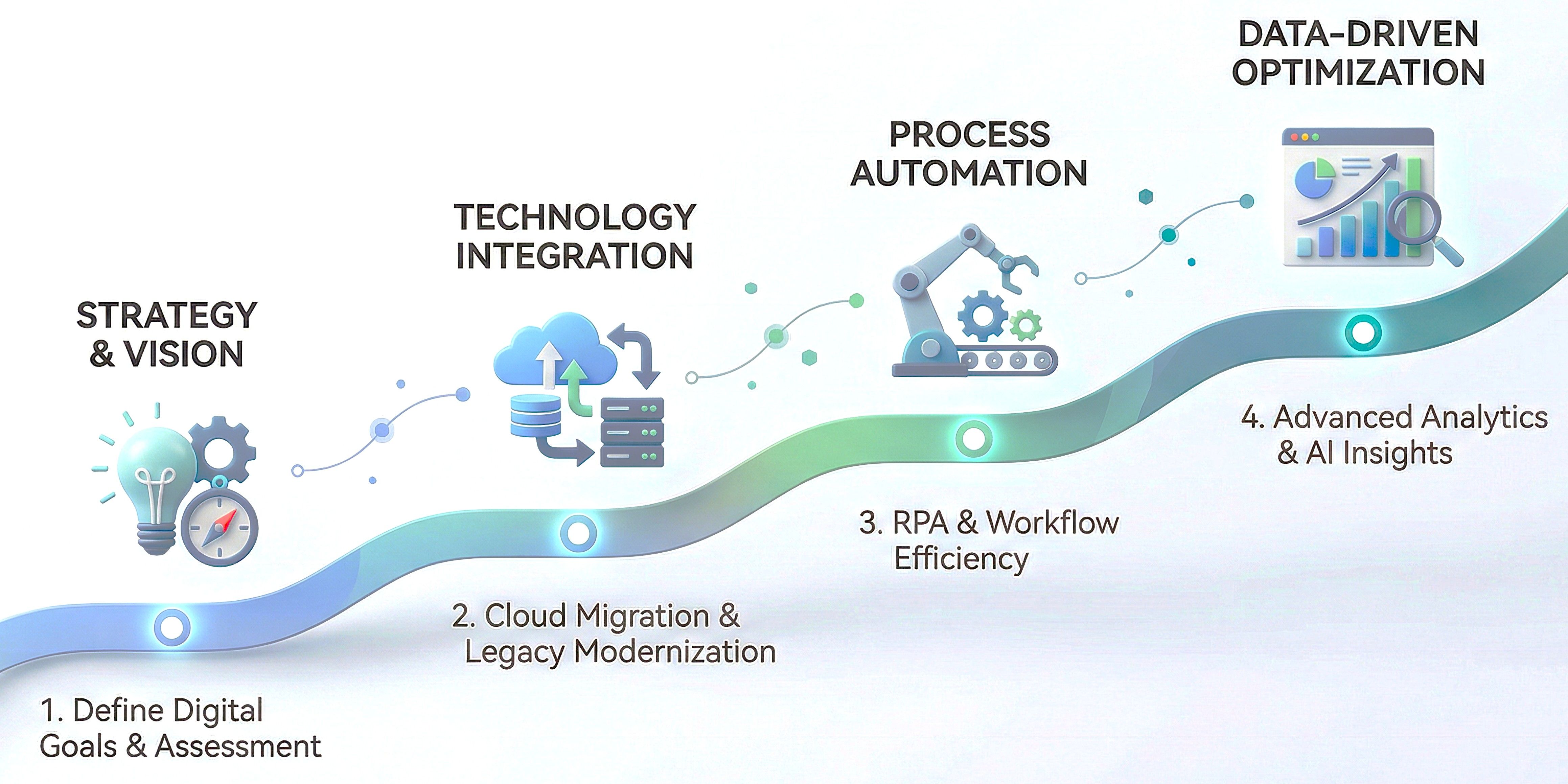
Cloud migration is rarely one pattern across an estate. The standard 7 Rs framework (Retain, Retire, Rehost, Replatform, Refactor, Repurchase, Relocate) has become the working language for placement decisions.
A typical large enterprise programme today distributes workloads roughly as:
- 40-60% rehost for non-strategic systems that are stable, well-understood and not worth refactoring.
- 20-35% refactor or replatform for high-value, long-lifespan, customer-facing systems where cloud-native services pay back the engineering effort.
- 10-25% retire or repurchase as part of estate rationalisation, often replaced by SaaS.
- A smaller share relocated or retained based on data residency, latency or commercial constraints.
The decision is workload-by-workload. A rehost is not laziness if the workload is genuinely transactional and short-lived. A refactor is not a virtue if the application is being retired in 18 months.
Cost: what makes 2026 different
Cost discipline has matured from "we should think about FinOps" into a standing operating practice embedded in product team budgets. The drivers are real:
- AI workload economics. GPU-backed inference and training workloads carry materially different cost curves to traditional cloud compute. Many enterprises discovered in late 2025 that their AI pilot was the largest line item on a multi-million-dollar cloud bill.
- Data gravity. Egress charges and cross-region replication are no longer rounding errors when datasets cross petabyte scale.
- Hardware efficiency. ARM-based instances, spot capacity and carbon-aware scheduling have moved from experimental to standard. So has reserved and committed-use pricing.
The implication is direct. FinOps cannot wait for after the migration. Cost allocation tags, automated alerts, budget guardrails and clear product-team ownership of cloud spend have to be in place before workloads start moving. Treating FinOps as a post-migration optimisation effort is what produced the cost surprises of the last three years.
Sovereignty, resilience and the regulatory shift
Two further factors define the 2026 migration conversation that did not feature meaningfully in 2022.
AI sovereignty and data residency. The EU AI Act entered force in August 2024 with phased application through 2026, alongside existing GDPR obligations and a tightening of data sovereignty expectations across regulated sectors. For Nordic and European enterprises, this has moved sovereignty from a procurement preference to a board-level architectural requirement. Multi-region and multi-cloud portability is no longer a theoretical hedge. It is a contract clause.
Concentration risk. The Cloudflare global outage of 18 November 2025 and the CrowdStrike Falcon update that triggered a global Windows IT outage on 19 July 2024 made concrete what architects had been raising in design reviews for years. Single-provider, single-region dependencies are now treated as resilience risks in their own right, regardless of the provider's SLA.
The architectural implications cut against the simplicity of full hyperscaler standardisation. Hybrid is back not as a transitional state, but as a deliberate choice for workloads where cost predictability, sovereignty or resilience matter more than feature velocity.
What a successful 2026 cloud migration actually looks like
The pattern that consistently produces predictable outcomes:
- A clear business case with measurable KPIs: target run-rate cost reduction, RPO and RTO, release frequency, customer-experience metrics.
- Comprehensive discovery, dependency mapping and a 7 Rs classification for every workload before any production move.
- A target architecture defined with explicit guardrails on identity, observability, data residency and security baseline.
- Migration waves rather than big-bang cutovers, each with rollback procedures and validation criteria.
- FinOps embedded from day one, with cost ownership in the product teams that consume the cloud.
- Documented exit strategy for every cloud commitment, with data export formats, deletion guarantees and portability patterns specified in contract.
- A Cloud Centre of Excellence or equivalent operating model that holds the platform standards while product teams ship against them.
What has changed is the willingness of enterprises to pay for the discipline upfront, having seen what skipping it costs over a three-year programme.
How Tarento partners on 2026 cloud migration
For enterprises planning a 2026 cloud migration, the choice of delivery partner now matters as much as the choice of platform. Tarento works with clients across the Nordics and India on cloud assessment, migration design, platform engineering and ongoing FinOps through its Cloud & DevOps and Application Modernization practices, with related capability in Enterprise Integration for the connections that legacy estates almost always depend on.
The same approach extends across SAP-led estates, where the SAP Ecosystem practice and the iVolve framework support cloud migration for the integration and ERP layers that sit underneath most enterprise cloud strategies.
If your 2026 plan is a cost reset, a sovereignty rebalance, a hybrid redesign, or all three, the work is concrete. Get in touch to talk it through.


AI Data Governance and Privacy: What Enterprise Architecture Teams Need to Get Right