Does every ERP integration and migration mean unpredictable cost and timeline risk?
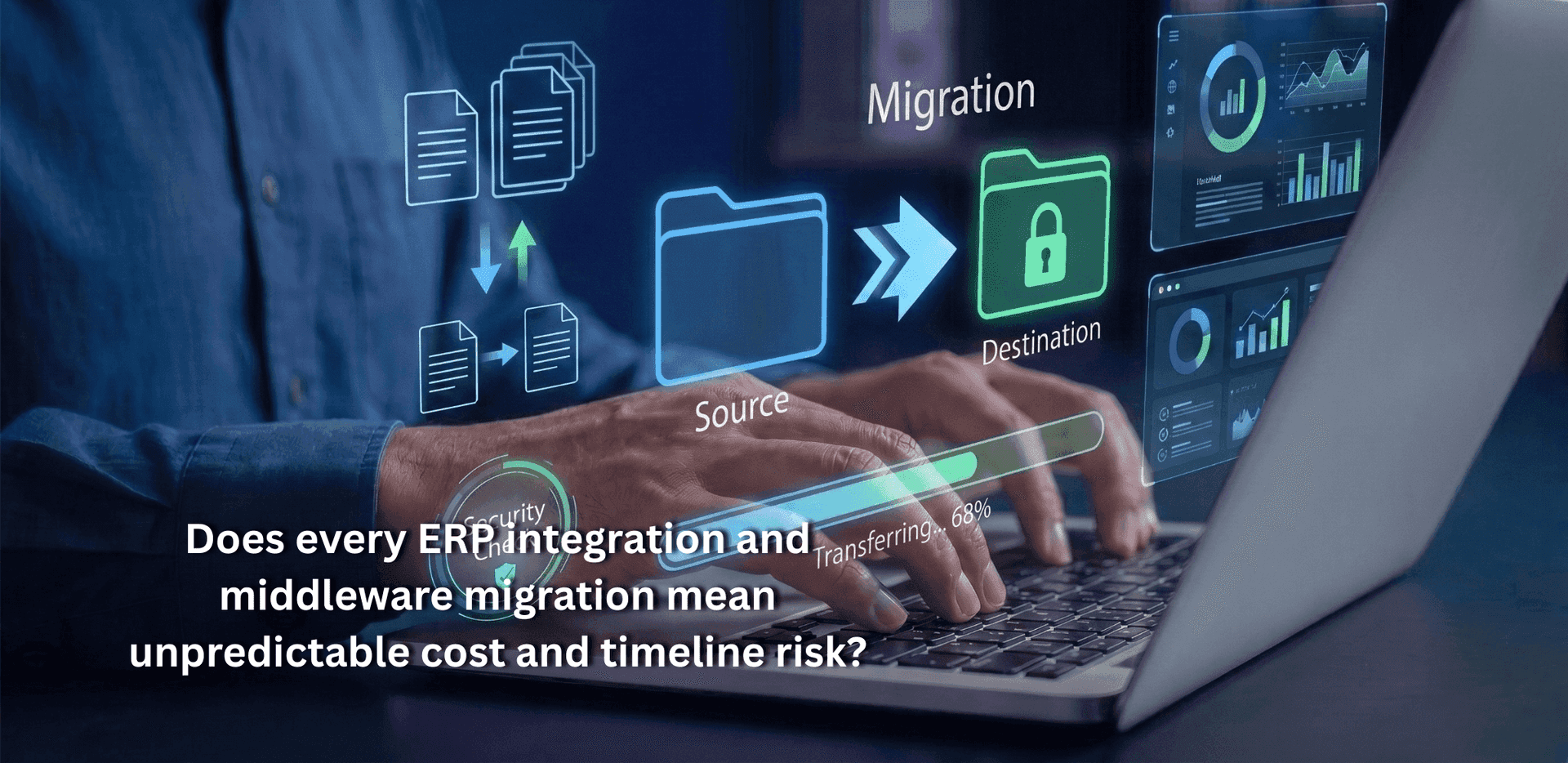
Whether you’re using SAP PI/PO, MuleSoft, BizTalk, or another integration platform, migration can be complex, expensive, and time-consuming. That’s exactly why we built iVolve.
iVolve helps organisations assess their current integration landscape, identify the right target platform, automate migration wherever possible, validate integrations through AI-assisted testing, and provide intelligent monitoring once they are live. For SAP PI/PO to SAP Integration Suite, iVolve can automate a significant portion of the migration and support migration journeys across other integration platforms.
iVolve helps organizations assess their current integration landscape, recommend the right target platform, automate migration wherever possible, validate integrations through AI-assisted testing, and provide intelligent monitoring once they're live. For SAP PI/PO to SAP Integration Suite, we can automate a significant portion of the migration and support modernization journeys across other integration platforms. The result is a migration a CIO can actually budget against, not one that gets re-scoped three months in.
Get the Details
Three ways to go deeper before you talk to us, useful whether or not you engage iVolve.
SAP PI/PO 2027 Readiness Checklist A short self-assessment covering the questions that actually determine your exposure: how many interfaces you're running, what proportion touch BPM or ABAP mappings, and how far out your extended-maintenance runway realistically extends. Get the checklist
iVolve Automation Benchmark Report The full source-to-target automation figures across SAP PI/PO, webMethods, MuleSoft, and BizTalk, broken down by complexity tier rather than a single headline number. Get the benchmark report
Migration Cost Estimator A worksheet for modelling your own migration cost range based on interface count and complexity mix, built so you can sanity-check any vendor's quote against your actual landscape, not just theirs. Get the estimator
Key Benefits of Migrating with iVolve
Automate what's genuinely automatable. iVolve classifies every interface into Simple, Medium, or Complex tiers and moves Simple interfaces in a single click. On SAP PI/PO to SAP Integration Suite, that reaches 70–80% at the landscape level. Full detail on how the tiering works: SAP PI/PO End of Support 2027 →
Close the visibility gap standard monitoring leaves open. Standard SAP CPI monitoring offers minimal payload detail and no restart option. iVolve's enhanced monitoring adds full error reports, one-click restart, and search by sender, receiver, message type, and application ID. See the full monitoring and firefighting-time case: Why 40–60% of Integration Engineering Time Is Lost to Firefighting →
Reduce the cost and risk of missing the 2027 deadline. SAP PI/PO mainstream maintenance ends 31 December 2027. After that, security patches, bug fixes, and regulatory updates stop. Why waiting has a real cost, not just a deadline: The Hidden Cost of Manual Migration →
Build an integration layer that's ready for what comes after migration. A migration that just relocates interfaces to new infrastructure doesn't fix what was already broken. iVolve pairs migration with governed monitoring and testing, including B2B/EDI test cases generated from real production data, so the platform a team lands on is operationally ready from day one, not a six-month cleanup project waiting to happen.
The iVolve Toolset and Engagement Path
iVolve is both a set of capabilities and a way of working with Tarento. Worth separating the two, since they answer different questions: what does the tool actually do, and how does an engagement actually run?
The Toolset
What iVolve does, independent of how you engage:
- Discovery. Automated landscape profiling before planning begins.
- Migration Automator. Connects to your current integration platform and moves selected artefacts in a single operation.
- Complexity tiering. Simple, Medium, and Complex classification sets the real automation rate before a timeline is fixed.
- Monitoring and reprocessing. Full error reports, one-click restart, search by sender, receiver, message type, and application ID.
- Testing. B2B and EDI test cases generated from real production data.
The Engagement Path
How working with Tarento on an iVolve migration typically runs:
- Discovery workshop. A short, structured session mapping your actual interface count and complexity mix, output is a real number, not a landscape-level guess.
- Migration Automator deployment. The automated pass runs against Simple-tier interfaces while Medium and Complex-tier work is scoped and staffed in parallel, not queued behind it.
- Validation and cutover. Migrated artefacts move through testing before go-live, with B2B/EDI test cases built from real production data rather than written from memory.
- Post-migration operations. Ongoing monitoring, reprocessing, and support once the platform is live, so the migration doesn't quietly become a second project six months later.
For the mechanics behind the toolset, the two deepest treatments are Why 40–60% of Integration Engineering Time Is Lost to Firefighting (monitoring, Migration Automator, automation benchmark) and SAP PI/PO End of Support 2027 (complexity tiering, per-interface automation range).
Explore the source-to-target combinations this covers: SAP PI/PO to SAP Integration Suite, webMethods to SAP Integration Suite, MuleSoft to SAP Integration Suite, and BizTalk to Azure Integration.
Customer Results
Organisations across manufacturing, retail, and industrial sectors have used iVolve to modernize their integration platforms without disrupting the business running on top of them.
Migrated 230+ SAP PI interfaces with zero disruption to business continuity Ashok Leyland →
Migrated SAP CPI to SAP Integration Suite in 12 weeks with 90–95% automation and zero downtime Plasman→
Delivered a hybrid integration platform supporting 400+ stores across six countries Elkjøp Nordics→
Accelerated migration from webMethods with consistent behaviour across every interface Florida Crystals Corporation→
Cut customer review comments by up to 80% recovering a stalled webMethods-to-MuleSoft migration European Specialty-Metals Manufacturer→
Frequently Asked Questions
1. What is SAP PI/PO migration automation, and how much of a migration can actually be automated?
SAP PI/PO migration automation is tooling that connects to an existing PI/PO landscape and moves interfaces to a target platform, typically SAP Integration Suite, without manual redevelopment. How much it automates depends on interface complexity, not a single number. Interfaces fall into three tiers: Simple interfaces (fully automated, no redesign needed), Medium interfaces (partly automated, covering proxies, EDI, and custom adapters, with some redesign required), and Complex interfaces (BPM, ABAP mappings, and custom logic that need manual reengineering). iVolve's benchmark for SAP PI/PO to SAP Integration Suite is 70–80% automation at the landscape level, an average across a full portfolio of interfaces, but any individual interface can automate anywhere from 20% to 90% depending on which tier it falls into.
2. What are the biggest challenges enterprises face migrating off their current SAP middleware?
Four come up consistently. First, underestimating interface complexity: an interface that looks routine in a landscape inventory can still have an ABAP mapping or BPM logic buried inside it, pushing it into the hardest tier to migrate. Second, standard monitoring limitations: out-of-the-box SAP CPI monitoring offers minimal payload detail and no restart option, so debugging happens by hand. Third, deadline pressure: SAP PI/PO mainstream maintenance ends 31 December 2027, and teams that start planning close to that date lose the ability to sequence the migration on their own terms. Fourth, blending benchmarks: landscape-level automation figures and per-interface rates get conflated, leading to timelines built on the wrong number.
3. When does SAP PI/PO support actually end, and what happens after?
SAP PI/PO mainstream maintenance ends 31 December 2027. Extended maintenance is available through the end of 2030, but at significantly higher cost, with limited scope, and no new functional improvements. After the mainstream deadline, SAP stops issuing security patches, bug fixes, and regulatory updates. The software keeps running; the support underneath it doesn't, which is a materially different risk profile for any organisation in a regulated industry.
4. How does iVolve reduce the cost and risk of an SAP Integration Suite migration?
By tiering interfaces by real complexity before a budget or timeline is set, rather than after. A Discovery phase profiles the full integration landscape upfront and classifies every interface into Simple, Medium, or Complex, so the Complex-tier workload is sized honestly before a go-live date is committed to. Manual work on Medium and Complex interfaces runs in parallel with the automated migration pass, not as a separate phase afterward, which is what keeps a realistic timeline realistic. Enhanced monitoring, full error reports, one-click restart, and search by sender, receiver, message type, and application ID also reduce the ongoing operational cost of running the platform once it's live.
5. Does migrating to SAP Integration Suite make an organisation AI-ready?
Migration alone doesn't. An integration layer becomes AI-ready when it pairs with governed monitoring, consistent artefact management, and testing built from real production data, exactly what an AI layer sitting on top of any modern integration platform depends on to make trustworthy decisions. A migration that just relocates interfaces to new infrastructure without addressing monitoring and governance reproduces the same blind spots on newer infrastructure.
6. What's the difference between the iVolve toolset and an iVolve engagement?
The toolset is what the technology does: automated discovery, migration automation, complexity tiering, monitoring, and testing. The engagement is how that toolset gets applied to a specific landscape: a discovery workshop that maps actual interface count and complexity mix, an automated migration pass run in parallel with manual Medium and Complex-tier work, validation and cutover through testing built from real production data, and post-migration monitoring and support once the platform is live. The toolset can be evaluated on its own merits, but the engagement path is what determines whether a migration actually lands on schedule.
Ready to see what actually automates in your landscape?
Don't wait for the 2027 deadline to force the timeline. A short discovery session maps your actual interface count and complexity mix, so you leave with real numbers instead of a landscape-level guess. Talk to an Integration Architect→

webMethods to SAP Integration Suite Migration: What Automation Really Delivers