

Summary: When AI makes purpose-built software cheap to build, the economics of managed services invert. A worked SAP Security AMS example shows a 40.5% lower run-rate and roughly 16-month payback, with the client owning the software at the end.
At Tarento, we have been re-architecting our managed services around AI. The reason is an economic one. For over a decade, application management has been sold by the hour. When the repetitive work inside a service can be done by purpose-built software, and AI collapses the cost of building that software, the economics of managed services invert. You stop renting hours and start owning an asset.
This article works the full ROI maths on a representative SAP Security AMS engagement, as an example of how we approach that shift.
In brief: automating the repetitive work of an AMS engagement cut the annual run-rate by 40.5%, paid back the net investment in roughly 16 months, and left the client owning the software rather than a stack of timesheets. The five-year net saving came to about 1.5 million SEK.
In This Article:
- The flaw in the labour model
- The shift to Service-as-Software, made viable by AI
- The ROI in full
- Where the value compounds
- The decision rule, and why AI keeps moving it
- Risk, contained rather than ignored
The flaw in the labour model
Traditional application management is labour arbitrage. You buy a pool of consultant hours and pay for them whether the work is skilled judgement or pure repetition. Three structural problems follow from that.
- Cost scales linearly with volume. There is no economy of scale, so the thousandth access review costs exactly what the first one did.
- Nothing compounds. After a five-year engagement you have funded tens of thousands of hours and own no asset, only the next invoice.
- Cost stays variable and people-bound. Monthly spend swings with ticket volume and depends on specific consultants, so key-person risk, ramp-up time, and knowledge attrition all become silent line items.
The model was rational for one reason only. The alternative, building bespoke software for each task, used to be slow and expensive. That constraint has now broken.
The shift to Service-as-Software, made viable by AI
Service-as-Software is the delivery of a service outcome by software rather than by people. It inverts the familiar logic of software-as-a-service: instead of buying software to operate yourself, you buy an outcome that software delivers. Rather than consultants performing user provisioning, access reviews, or firefighter-log analysis by hand, purpose-built applications perform that work while consultants supervise, handle exceptions, and govern. The client owns the software.
The gating cost was always the build. Replacing a service team with custom tools historically demanded long, costly development that pushed payback years out and kept the labour model sensible. AI-assisted development changes the slope of that curve. Code generation, agentic build tooling, and reusable automation scaffolds cut the cost and time-to-value of the very tools that perform the service, often by half or more. Once the build becomes cheap and fast, the build-versus-staff decision flips. The maths below shows where the tipping point sits.
The ROI in full
| Metric | Value |
|---|---|
| Current annual AMS cost (A) | 1,008,000 SEK |
| Steady-state cost after automation (S) | 600,000 SEK |
| Annual saving (ΔC = A − S) | 408,000 SEK (40.5%) |
| Year-1 run-cost during the build (M1) | 660,000 SEK |
| Build cost | 480,000 SEK |
| Net incremental outlay (Bnet) | 132,000 SEK |
| Payback | ~16 months |
| Five-year net saving | ~1.5 million SEK |
| NPV at 10% discount rate | ~1.06 million SEK |
| Five-year return on net investment | >1,000% |
The annual saving is straightforward: a steady-state cost of 600,000 SEK against a current 1,008,000 SEK is a 408,000 SEK cut, or 40.5% off the run-rate.
The build-credit effect is what makes the case unusual. Automation begins delivering during the build year, so the Year-1 run-cost of 660,000 SEK already sits 348,000 SEK below the do-nothing baseline. That credit funds most of the build, which means the true incremental outlay is only 132,000 SEK: the 660,000 run-cost plus the 480,000 build, less the 1,008,000 baseline. A net 132,000 SEK acquires an asset that saves 408,000 SEK every year, because the asset starts paying for itself before it is finished. Payback lands at roughly 16 months from kickoff.
The returns follow from there. Against a flat baseline, the three-year net saving is 684,000 SEK and the five-year is 1.5 million SEK. Discounting the net cash flows at a 10% cost of capital gives an NPV near 1.06 million SEK. Measured against the net incremental investment, the five-year return exceeds 1,000%. Even measured against the full build cost, it is about 310%.
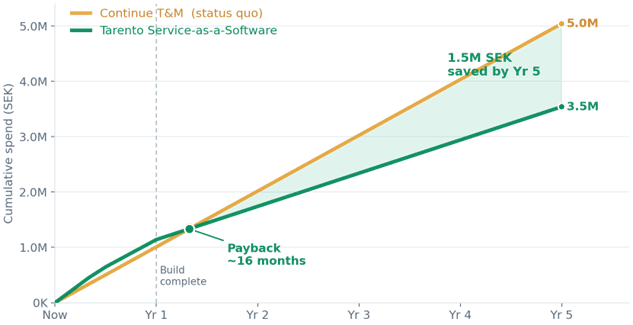 Figure 1 — Cumulative spend over five years. The transformation carries a small Year-1 hump, crosses the status-quo line at ~16 months, and opens a ~1.5M SEK gap by Year 5. Baseline held flat (conservative).
Where the value compounds
Cost reduction is the headline, not the substance. The durable value sits in four dividends that compound over time.
- Cost decouples from volume. The labour curve is a straight line through the origin: double the work and you double the bill. Software carries a high fixed cost and a near-zero marginal cost, so its curve is almost flat, and the gap widens with every new user, entity, and audit. The figures above hold volume flat, which is the conservative case. At just 10% annual growth in security workload, the five-year saving rises from about 1.5 million to about 2.6 million SEK.
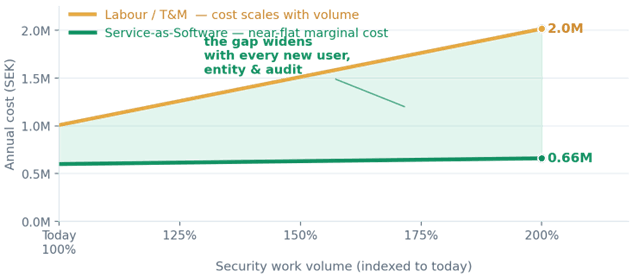 Figure 2 — In a labor model, cost tracks volume one-for-one; in a software model it barely moves. The shaded area is value that accrues automatically as the organization grows.
- Unit cost falls towards zero. Today's effective rate is 420 SEK per human hour. After automation the billed rate is around 312 SEK, but the number that matters is the marginal cost of one more transaction, which trends towards zero. The ten-thousandth automated review is essentially free.
- You own an appreciating asset. At the end of the engagement the client owns a suite of applications, not a pile of timesheets. Those assets can be extended cheaply with the same AI tooling, redeployed to new entities, and capitalised. The labour model leaves no balance-sheet residual.
- Governance becomes a by-product. Because software executes the work, every action is logged, consistent, and evidenced. Audit preparation, historically a spiky manual cost, becomes a query. Segregation-of-duties checks and certification run continuously instead of in pre-audit scrambles.
The decision rule, and why AI keeps moving it
For any engagement, transformation pays when the net build cost is below the saving it produces over an acceptable payback horizon. Expressed simply, transform when B < (A − S) × Pmax + (A − M1), where A is the current annual cost, S the steady-state cost, M1 the Year-1 run-cost during the build, and Pmax the longest acceptable payback.
AI pushes both terms in your favour. It lowers the build cost, and by landing automation sooner within the build year it raises the in-year credit. In the worked example, the in-year credit is 348,000 SEK. Once the build cost falls below that figure, the in-year automation savings exceed the build spend and the programme turns cash-positive in Year 1. As AI compresses build timelines, that is an increasingly common position to be in.
Risk, contained rather than ignored
The classic objection to building instead of buying hours is execution risk. The phased model contains it. Value lands application by application, with each phase funding the next, so the programme is never a single large bet. AI tooling lowers the risk further: shorter timelines leave less room for requirements to drift, and iteration is cheap. Residual automation error is managed the way good AMS has always managed human error, through supervision, exception queues, and human-in-the-loop control over the highest-risk actions. The ROI case already pays for that oversight, since steady state is 160 hours a month, not zero.
Conclusion
An hour is consumed the moment it is sold. Software, once built, keeps working. AI has removed the last economic reason to keep renting the former when you could own the latter. For any AMS engagement with real repetitive volume, the question is no longer whether to make the shift, but how quickly the build can be financed out of the savings it immediately begins to produce. Usually, that is well within the first cycle.
If you are reviewing your application management contracts and want to model what this looks like for your own engagements, talk to our managed services team.
Figures are illustrative, based on a representative SAP Security AMS engagement, with all amounts in SEK. The baseline is held flat (no time-and-materials inflation or volume growth) as the conservative case. NPV uses a 10% discount rate. Tax effects are excluded.