The Modern Data Platform: A Tarento Guide Beyond Migration

Most organisations that invest in a new data platform are really just moving the same problems to a more expensive address. The infrastructure changes. The governance gaps, the silos, and the trust issues don't — because migration and modernisation are treated as the same project when they are, in practice, entirely different pieces of work.
This guide sets out what actually distinguishes a modern data platform from a relocated legacy one: the characteristics that define it, the reasons most data programmes stall before they deliver value, and the four-step practice that separates organisations that get real returns from data from the ones still waiting for their investment to pay off.
Executive summary
Five things determine whether a data platform investment becomes a genuine business asset:
- Modernisation is a different goal from migration, and confusing the two is the most common reason data programmes underdeliver
- A platform only qualifies as "modern" if it is elastic, governed by default, and built for access beyond IT
- Most data programmes stall on a predictable set of structural and cultural obstacles, not technology limitations
- Data analytics earns its investment through three outcomes: sharper customer experience, real operational efficiency, and usable prediction — not through dashboards for their own sake
- Building a modern data platform follows a repeatable practice: define outcomes, assess honestly, implement with people and process alongside technology, and keep evolving
The pattern across all five: organisations that treat data as infrastructure get infrastructure. Organisations that treat it as a strategic asset, with the governance and culture to match, get a platform that compounds in value.
1. Modernisation is not migration with extra steps
Moving data from one system to another changes where it lives. It does nothing for whether that data is trustworthy, accessible, or governed once it arrives. Many organisations are still running data architectures and practices that were designed for a slower, more siloed way of working, and a lift-and-shift migration onto newer infrastructure preserves every one of those limitations — just on a more modern bill.
The distinction matters because trust, not storage, is the actual constraint. The more an organisation relies on data-driven decisions, the more that data needs to be complete, accessible, and genuinely trustworthy. A platform that simply hosts data more cheaply doesn't solve for any of that. A platform designed to resolve governance, quality, and access challenges — and built to absorb AI and machine learning as they mature — does.
Where to start: Before scoping a migration, define what "modern" needs to mean for your organisation specifically: what decisions need to get faster, which teams need self-serve access, and which compliance obligations the new environment must satisfy from day one.
The delivery implication: This is why Tarento's approach to data modernisation, through DataVolve, starts with discovery and architecture rather than a straight lift-and-shift. A migration that doesn't address the underlying governance and access model simply reproduces the old platform's problems on newer infrastructure.
2. Three characteristics actually define a modern platform
A genuinely modern data platform is distinguished by three properties, and a platform missing any one of them is a modern-looking version of the same legacy problem.
-
Elasticity. Cloud-native platforms scale storage and compute independently, and let organisations swap components in and out as better tools emerge, rather than locking into one vendor's fixed capacity. This is what allows a platform to grow with the business without a forklift upgrade every few years.
-
Governance by default, not by exception. In legacy systems, governance is usually retrofitted — a set of manual controls layered on top of infrastructure that was never designed with access management in mind. A modern platform unifies the data environment so that access controls, auditing, and compliance are native functions, not a separate project. This is also what builds genuine trust in the data: users are far more likely to rely on data they know is properly governed.
-
Data for everyone, not data for specialists. Insight shouldn't be gated behind a request queue to the analytics team. A modern platform makes data usable by people across finance, HR, legal, and operations, not just by those with technical training — which is precisely where unexpected value tends to surface, in functions that were never considered "data teams" in the first place.
Where to start: Audit your current platform against these three properties specifically, rather than against a feature checklist. A platform can have excellent dashboards and still fail on governance or accessibility.
The delivery implication: Tarento's Data & Analytics practice builds against all three simultaneously, because a platform that's elastic but ungoverned, or governed but inaccessible to business users, still isn't a modern platform — it's a partial one.
3. Most data programmes stall for the same eight reasons
The obstacles that keep organisations from getting value out of their data are strikingly consistent across industries. Recognising them early is usually more useful than any single piece of new technology.
- Storage growth outpacing infrastructure — as data volumes grow, organisations often need to expand or re-tier their storage faster than they'd planned, particularly where archival and active data have very different cost profiles.
- Fragmented sources — data scattered across systems creates silos, duplication, and inconsistency, and closing those gaps takes real investment in integration tooling, not just intent.
- Sheer data volume — the pace of data generation now regularly outstrips an organisation's ability to analyse it, and organisations with weak data management practices frequently don't even have a full inventory of what they hold.
- M&A integration — merging technology estates is one of the biggest potential wins of an acquisition and one of the hardest things to execute, since every merging organisation brings its own systems, processes, and assumptions.
- Locked-out business users — security concerns and siloed systems often leave non-technical staff dependent on IT for basic reporting, which delays decisions that shouldn't need to wait.
- Talent scarcity — demand for skilled data professionals continues to outpace supply, and talent gaps show up directly as delayed initiatives and underused platforms.
- Data quality and trust — incomplete, inconsistent, or outdated data leads directly to flawed analysis, however sophisticated the platform sitting on top of it.
- Security and compliance exposure — the more data an organisation holds, the more it has to protect, and sectors like finance and healthcare carry additional regulatory scrutiny on top of the general cyber risk.
The cultural dimension is at least as significant as the technical one. In a survey of chief data officers, 62% cited difficulty changing organisational behaviour as a top challenge, and 47% pointed to a lack of data literacy — both ahead of most purely technical obstacles. Separately, another survey has found that only around 21% of firms consider themselves to have a genuinely data-driven culture, despite years of investment in the underlying technology.
Where to start: Map these eight challenges against your own environment honestly before selecting technology. Most organisations will recognise at least four or five as live issues, and the ones with the greatest business impact should drive platform priorities, not the other way round.
The delivery implication: This is where a cross-industry implementation partner earns its place. Recognising which of these eight challenges is actually the binding constraint — rather than the one that's easiest to point to — takes pattern recognition from having solved the same problem in other sectors.
4. Data analytics has to earn its keep through three outcomes
A modern platform is infrastructure. Data analytics is what turns that infrastructure into business value, and it does so through three genuinely distinct outcomes.
-
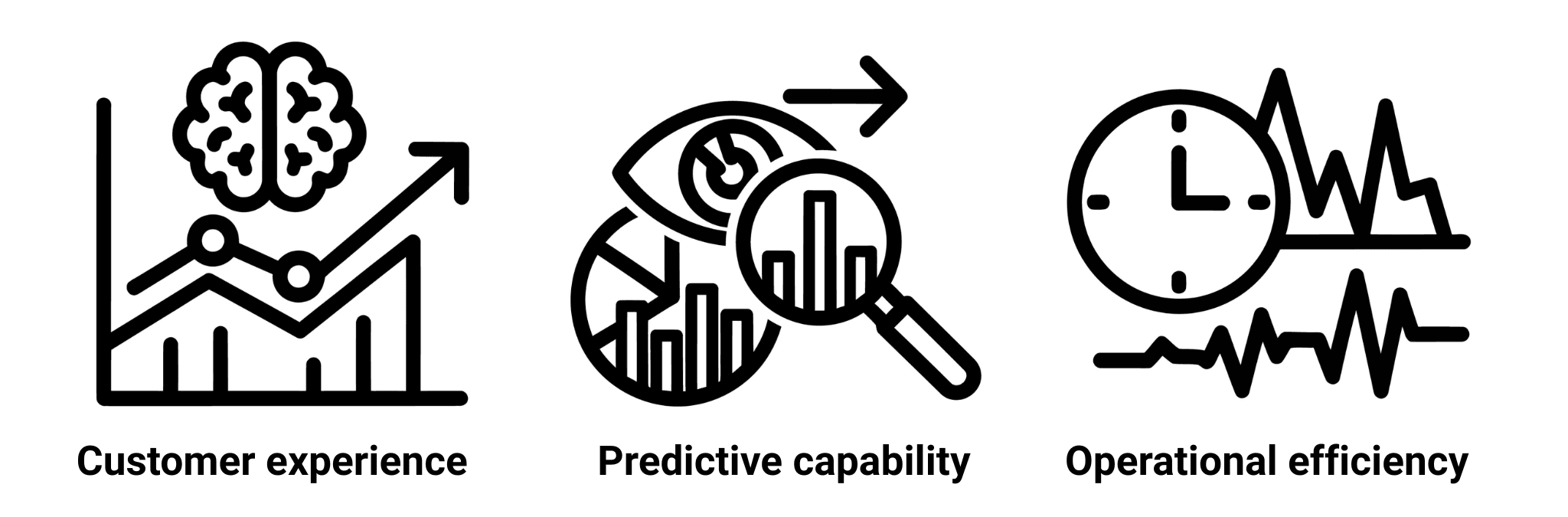
Customer experience. Behavioural and transactional data enables more personalised marketing, better product recommendations, and pricing that reflects actual customer value rather than blanket assumptions.
-
Operational efficiency. Analytics surfaces the inefficiencies leadership can't see from a dashboard summary — where processes are duplicating effort, where cost is leaking, and where time-to-market is being lost to avoidable friction.
-
Predictive capability. Running historical data through predictive models turns analytics from a rear-view mirror into a forecasting tool, with direct application in areas like demand planning, inventory management, and sales forecasting.
McKinsey's most recent State of AI research, published in late 2025, found that while roughly 79% of organisations report regular generative AI use in at least one function, only around 5–6% attribute significant financial impact to it — a gap McKinsey attributes to the same root cause: workflows and data foundations that were never redesigned to support the new capability, not the model itself.
Where to start: Pick one of the three outcomes above and identify a single high-value use case where better data would move a number leadership actually tracks. Momentum comes from proving value on a bounded case, not from a platform-wide mandate.
The delivery implication: This is the same discipline Tarento applies across Generative & Agentic AI engagements — AI and advanced analytics only compound in value when the data foundation underneath has already been built to support them.
5. Building the platform: a four-step practice, not a purchase
A modern data platform isn't something an organisation buys off the shelf and switches on. It's built through a repeatable practice.
-
Define business outcomes first. Start from specific, high-value use cases and quick wins rather than a broad mandate to "modernise data." Identify business sponsors outside IT — a platform championed only by technology leadership rarely becomes transformational, but one with genuine buy-in from sales, finance, or operations leadership usually does.
-
Assess honestly. Most organisations already have more usable data than they realise. The goal of an assessment is modernisation, not migration: understanding existing systems, integrating legacy and new sources seamlessly, and building a proper data catalogue with metadata that lets non-technical users find what they need without submitting a ticket.
-
Implement with people, process, and technology together. A modern data platform is not a product purchase — it follows the same discipline as any transformation programme. Architecture should be cloud-friendly and modular by design, favouring best-of-breed components over a single-vendor lock-in that constrains future choices.
-
Keep evolving. A data platform is a continuing practice, not a finished project. Data science, AI, and machine learning are moving fast enough that the highest-value use cases three years from now may not exist yet — which is precisely why the systems and culture need to be built for ongoing change rather than treated as a one-off deployment.
Where to start: Run the first two steps — define and assess — as a structured discovery exercise before committing to any platform or vendor. Most of the expensive mistakes in data modernisation happen when organisations skip straight to implementation.
The delivery implication: For regulated sectors especially — finance, healthcare, and the public sector — this four-step approach needs to produce a genuine multi-year roadmap with concrete milestones, not just an architecture diagram. That roadmap discipline is where Tarento's Data & Analytics and DataVolve practices work together, from initial assessment through to a platform built to keep evolving.
What this adds up to
A modern data platform is not a bigger, cheaper, cloud-hosted version of the system it replaces. It's an environment built on three non-negotiable properties — elasticity, governance by default, and access for everyone who needs it — and delivered through a practice that treats people and process as seriously as technology.
- Migration moves data. Modernisation makes it trustworthy, governed, and usable.
- The eight most common obstacles are more cultural than technical — culture and literacy consistently rank above pure infrastructure limits in independent research.
- Analytics only pays off when it's tied to a specific outcome: customer experience, operational efficiency, or prediction — not deployed as a general capability and hoped for the best.
- The build is a four-step practice — define, assess, implement, evolve — not a single procurement decision.
For organisations planning this work, the practical starting points are:
- Separate the migration conversation from the modernisation conversation explicitly, even if they happen in the same programme
- Audit the current platform against elasticity, governance, and accessibility — not against a feature list
- Name the specific business outcome the investment needs to move, before selecting technology
- Build the data catalogue and governance model at the same time as the architecture, not afterwards
Ready to modernise, not just migrate?
If your organisation is evaluating a new data platform, or inheriting one that technically works but nobody fully trusts, Tarento can help identify where the real constraint sits — technical, cultural, or both — and build the roadmap to resolve it.
Get in touch to discuss what a modern data platform should look like for your organisation.


Five Enterprise Cloud Infrastructure Foundations That Define Reliability